Google’s AI Agents Raised a Lab Hit Rate to 42.1%, but the Work Is Early
Google’s AI agents raised an aptamer hit rate to 42.1% across three robotic lab rounds, but the result is research, not a treatment.
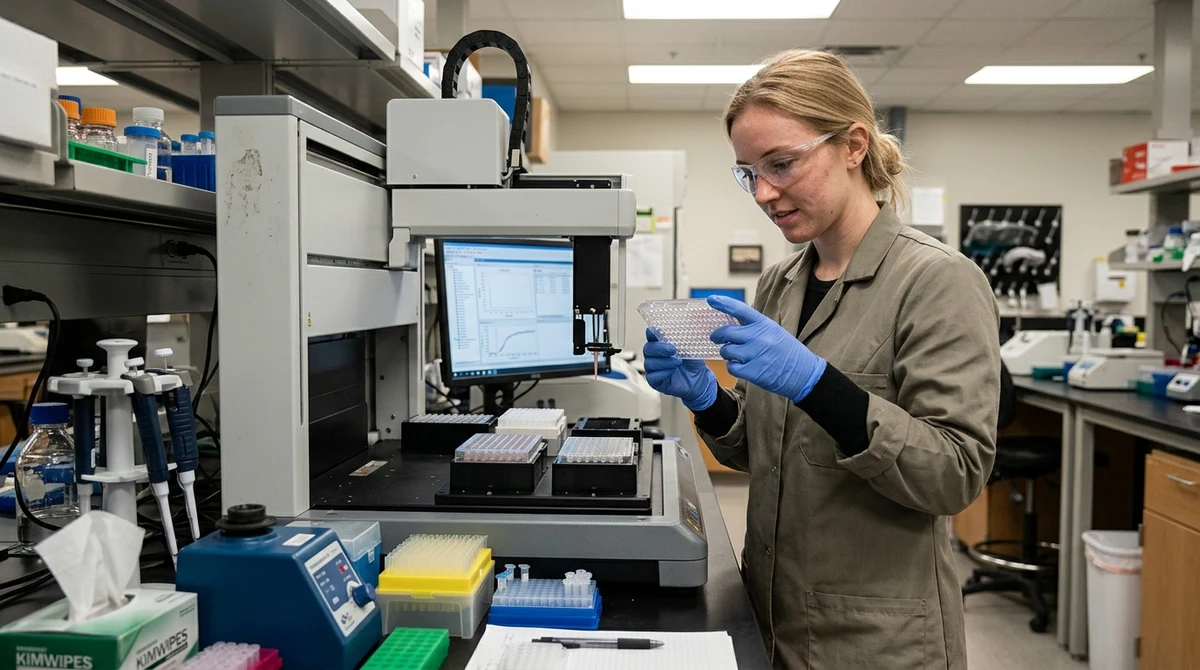
Google Research said on October 16 that AI agents had planned and run robotic lab experiments, then used the results to refine molecular designs. For an alpha-thrombin aptamer, the reported on-target hit rate reached 42.1% by the third round. This is early research, not a clinical advance or a ready-to-use lab product.
A digital model checks the lab before robots act
Google’s VERID system tracks the live state of a lab workcell, including equipment, reagent volumes and pipette tips. It lets an agent simulate a protocol and checks commands before they reach a liquid-handling robot.
That safety layer matters because a command can look valid in software but fail in a physical lab. In one reported case, the simulator blocked an aspiration that would not fit the equipment. The agent then revised its plan.
Real results changed the next design
In a three-round study, Google reported that the alpha-thrombin aptamer’s on-target hit rate rose as follows:
- First round: 0%
- Second round: 26%
- Third round: 42.1%, with 98.5% specificity
The agents changed their designs after experimental results exposed a problem with sequence folding.
A second target, myoglobin, showed a different risk. An early design strategy favored molecules that bound too broadly. Google reported that specificity fell before the agents changed course. The third-round on-target hit rate reached 33.5%. Lab feedback, not a computer prediction alone, revealed the failure.
Promising binders are not treatments
A separate protein-design study reported binders with single-digit nanomolar affinity for fibroblast activation protein alpha, a cancer-associated target. That measures binding strength in laboratory tests. It does not show that a binder treats cancer or is safe for people.
The evidence has limits. Google’s VERID paper describes initial tests using dye and water mixtures, while the aptamer and protein studies report specific experimental campaigns. Google says humans reviewed sequences and protocols and supervised robot runs. The company describes combining VERID with closed-loop protein discovery as a next step, not an established autonomous service.
The studies show how lab experiments can help AI agents revise scientific designs. They do not yet establish how reliable or scalable the approach is, or whether it will work in biological applications.
Google published its research reports on October 12, 14 and 16. The three reports offer an early look at how robotic experiments can guide design changes, while leaving questions about reliability, scale and biological applications open for further study.